The Itential Platform is an enterprise infrastructure and network automation and orchestration platform. It connects AI reasoning and low-code workflows with deterministic execution across cloud, physical, and virtual networks.
1. One Platform for Network and Infrastructure Automation
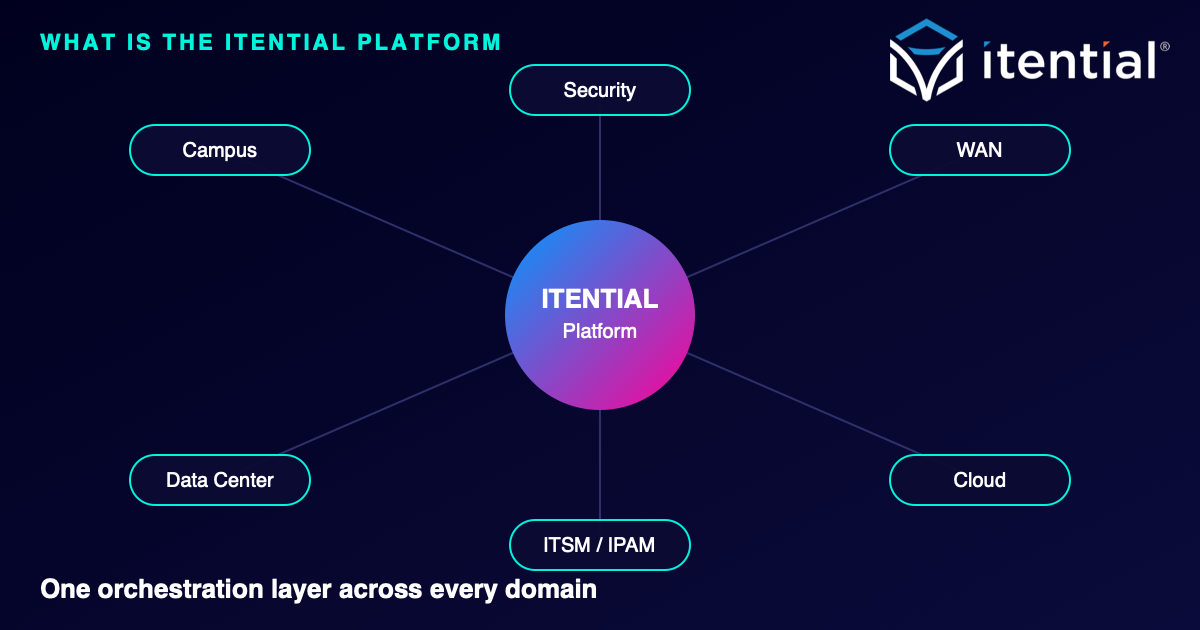
The Itential Platform is an automation and orchestration platform built for network and infrastructure teams. It sits above your individual tools, such as controllers, cloud APIs, IPAM systems, ticketing tools, and CLI-driven devices. It coordinates them into end-to-end processes.
Most organizations don’t lack automation. They have scripts, Ansible playbooks, vendor controllers, and CI jobs, each solving one narrow problem. What’s missing is the layer that connects them, enforces order, handles failure, and gives the business a single, governed way to request and run change. That layer is what Itential provides.
Instead of asking engineers to stitch tools together by hand, the platform lets you design a process once, such as provisioning a circuit, onboarding a device, or remediating a compliance violation. You can then run it consistently, on demand or from an event, across every domain you manage: campus, data center, WAN, cloud, and security.
2. Automation Studio: Designing Workflows Visually
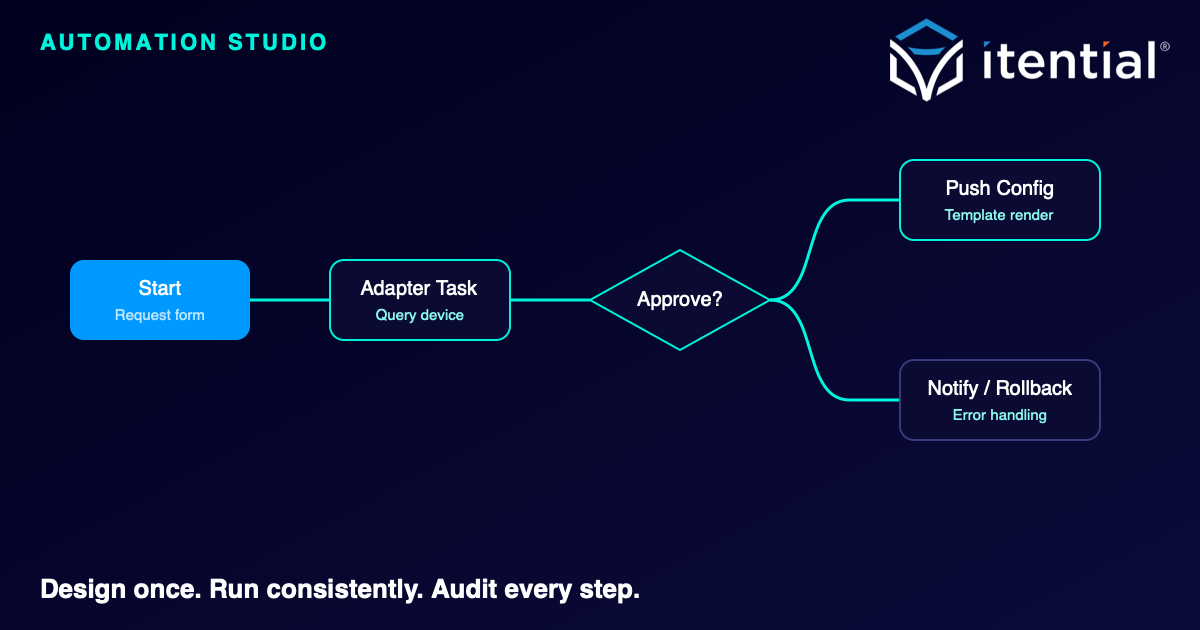
At the heart of the platform is a workflow engine and the design environment around it. In Automation Studio, engineers build workflows on a visual canvas. Each task calls an adapter, runs a transformation, makes a decision, or waits for a human approval.
Workflows are more than a flowchart. They support branching, looping, error handling, child workflows, and manual steps. Input forms collect the data a request needs. Templates render device configuration. Projects bundle related assets so they can be versioned, shared, and promoted from development to production.
The result is automation that reads like a process diagram yet executes like code. Network architects can understand it, engineers can extend it, and operations teams can trust it, because every run is recorded and every step is visible.
3. Adapters, Integrations and Gateways: Connecting Your Entire Estate
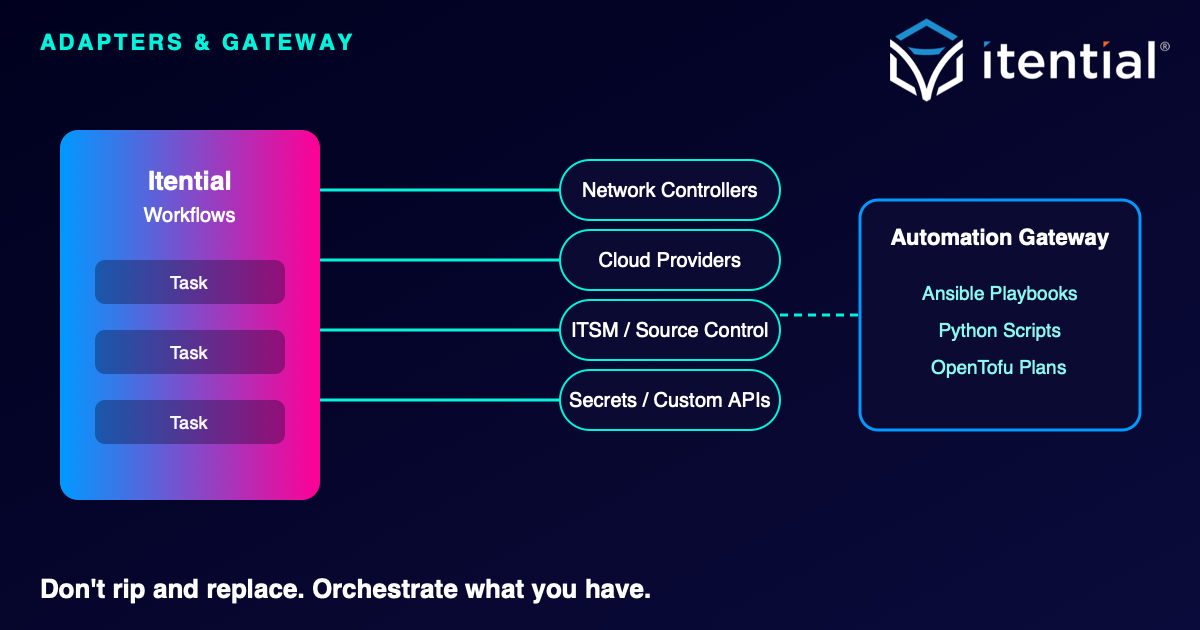
A workflow is only as useful as the systems it can reach. Itential connects to them through adapters or integrations which are pre-built integrations that expose a system’s capabilities as drag-and-drop tasks. Adapters cover network controllers, cloud providers, IT service management, source control, secrets managers, and more. You can also build your own for anything that has an API.
For work that has to run close to the devices, the Itential Automation Gateway executes Ansible playbooks, Python scripts, and OpenTofu plans inside your network. Workflows call those services as tasks. Existing automation assets keep working, and the platform orchestrates them rather than replacing them.
This is a key idea behind Itential. You don’t rip and replace what already works. You bring it under one orchestration layer.
4. Operations, Lifecycle, and Configuration Management
Running automation at scale takes more than building it. The platform includes applications for the day-to-day work of operating a network.
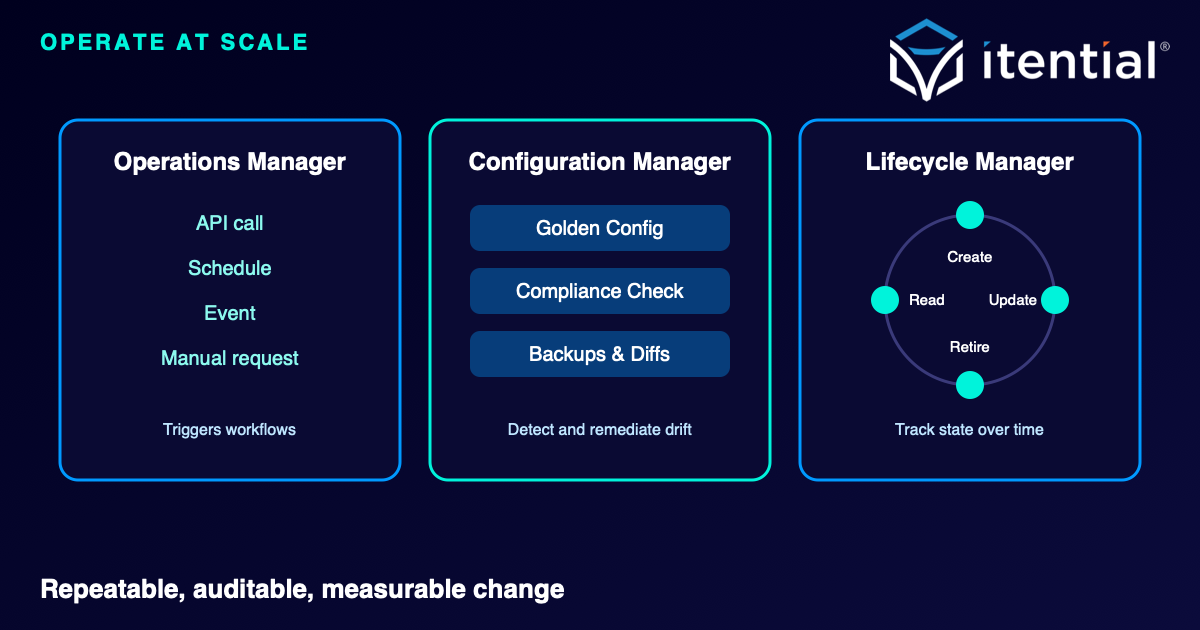
Operations Manager exposes workflows as triggered automations, whether by API call, schedule, event, or manual request. This makes them easy to consume from other tools.
Configuration Manager handles device inventory, backups, diffs, and golden configuration. You define the standard, run compliance checks against it, and remediate drift through the same workflows.
Lifecycle Manager models services as resources with defined actions. It tracks the state of each instance over its whole life, from create through update to retire, rather than treating every change as a one-off.
Together these turn automation from a collection of scripts into an operational capability. Changes become repeatable, auditable, and measurable.
5. AI Agents, Governance, and Control
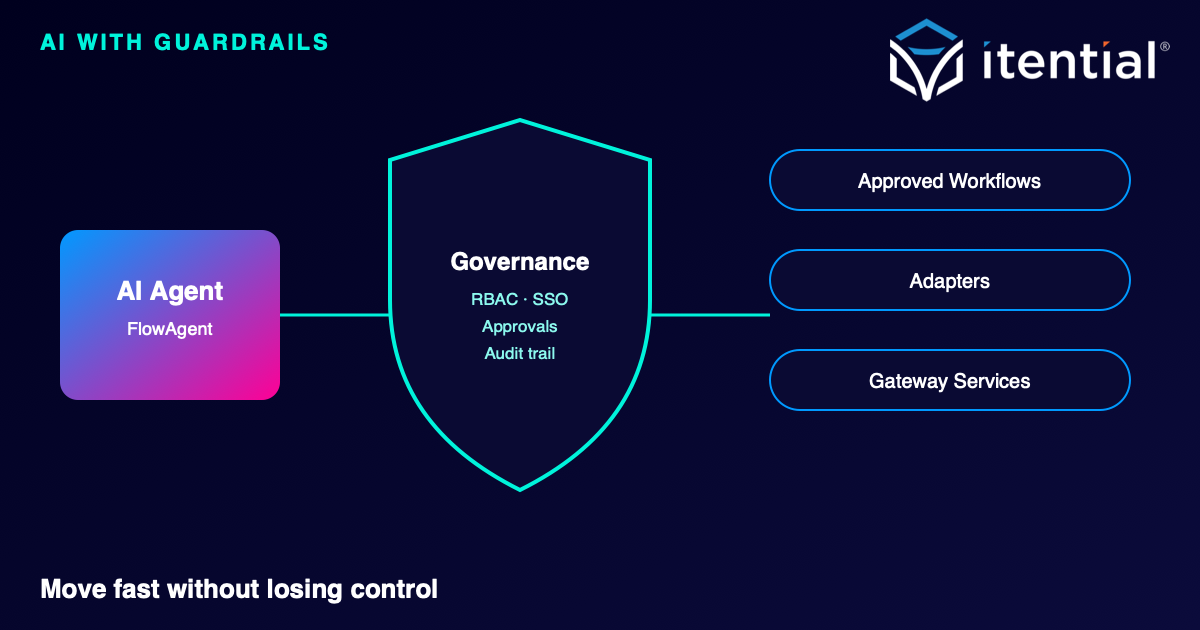
As teams explore AI, the hard question is how to use it safely against production infrastructure. The Itential Platform answers by pairing agentic capabilities with the deterministic automation underneath. With FlowAgent, AI agents can pursue an objective and call approved tools such as workflows, adapters, and gateway services. They can only use the tools you have granted them, and every session is tracked.
Governance runs through the whole platform. Role-based access control, single sign-on, service accounts, and approvals decide who can run what. Detailed job histories give you the audit trail that compliance teams expect.
The outcome is automation that moves fast without losing control. Engineers can design with confidence, the business can request change through a governed front door, and AI can be applied where it helps, inside guardrails you define.
Getting Started with Itential
The best first step is a single, well-chosen use case, such as device onboarding, a compliance check, or a standard provisioning request. Build it as a workflow, connect the systems it needs, and put it in front of the people who will use it.
Each use case you add makes the next one faster, because adapters, templates, and workflows are reusable. That compounding effect is what the Itential Platform is designed to deliver.
For more information check out itential.com
Leave a Reply